
What’s your ikigai?
I’m a sucker for many things Japanese. I did a Japanese degree, lived out there for a long time, even met my wife there (she’s Dutch but that’s another story). Everything just talks to me more succinctly in Japanese. Continuous improvement? Kaizen. Management by walking around? Gemba. Finding beauty in the impermanent? Wabi-sabi. Or how about kintsugi, the art of mending something that’s broken and making it even stronger? How great is that? It seems I’m not the only devotee. One of the many concepts people around the world have taken on board from Japan is ikigai, our reason for being. The idea is that everyone has their ikigai and discovering it is essential to bringing satisfaction and meaning to our lives. In truth, it really developed from a notion around living a full life in all areas. However, the popular model shown below is attuned to purpose and regularly does the rounds in different formats on LinkedIn. The full version consists of what I’m great at (the activities and skills I’m good at, whether I like it or not), what I love doing (the activities I can lose myself in), what the world needs (the bigger than me things I can do), and what I will be paid for (the bottom-line for the way forward). With purpose coaching, we can leave this last one out with coachees who are not looking for a way forward or goals directly connected with a profession or vocation. However, it does add a practical reality check.
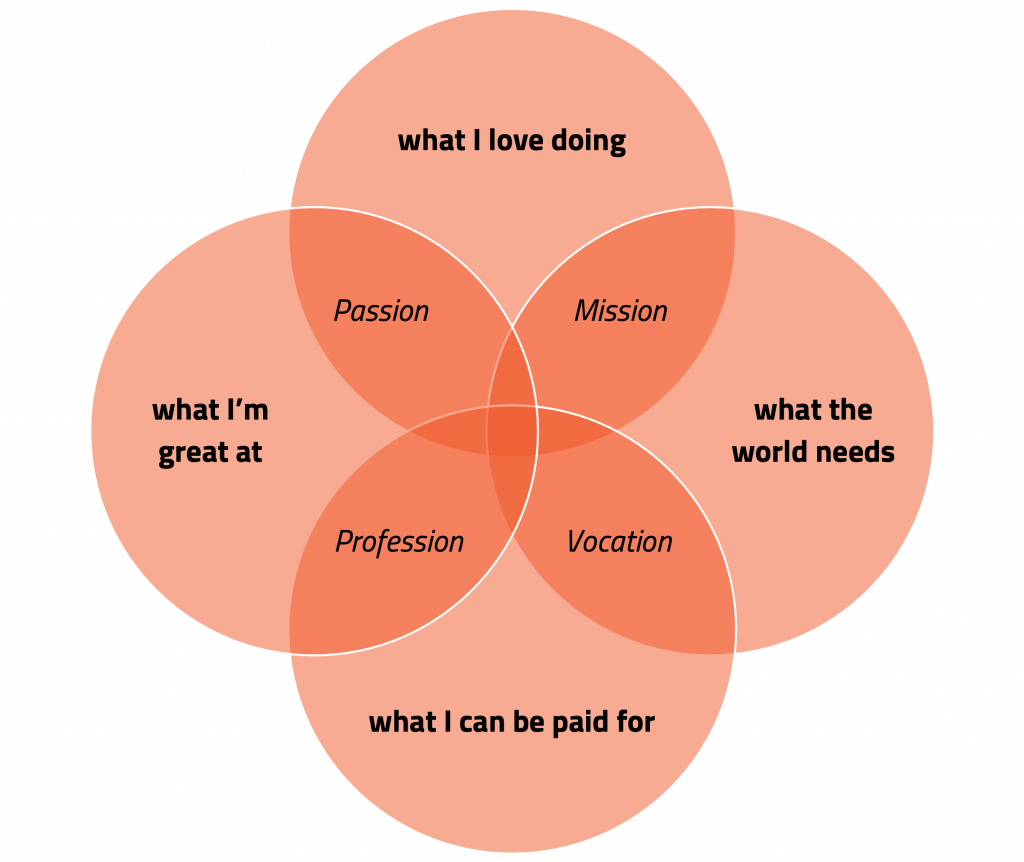
As I keep saying, anything that grows our self-awareness paves our way forward. For this, filling in the circles (and who doesn’t like a Venn diagram?) is a really useful activity to generate ideas and then also to test whether these ideas overlap across the different parameters. Find something that talks to all four circles and you’re halfway there to determining your life purpose, your worthy goals, your element, your reason for getting out of bed every morning – whatever it is you’re calling and looking for in your way forward. Let’s not forget the roots of the model though. Sharma, in particular, is strong on living a full (and good) life. This is tied up with activities such as the Wheel of Life, where you determine what percentage of your time you spend in different areas such as exercise, romance, relationships, community, work, and so on. In this model, a healthy, well-rounded life is one where there’s balance between the various elements. Again, an illuminating reality check as it truly talks to leading yourself. If you’re looking for your way forward, what’s your ikigai?
Julian
I help people lead their own way forward


Leave a Reply