
What’s holding you back from genius?
As with many of us, the end of year was an opportunity to catch up on reading and re-reading. One of the books I went back to was The 15 Commitments of Conscious Leadership (Dethmer, Chapman, and Klemp) on the recommendation of a good friend. It’s been around for ten years or so, a great amalgam of various approaches and tools out there in the leadership world. Fundamentally, it talks of leading above the line – being open, curious, and committed to learning.
This time, it was the Zone of Genius commitment that stood out, which comes in turn from Hendricks’ book The Big Leap. The sweet spot in the ikigai diagram where talents, passions, and strengths intersect.
I commit to expressing my full magnificence and to supporting and inspiring others to fully express their creativity and live in their zone of genius.
A lovely, noble commitment, eh?
The basic model of the four zones is as below. For more detail, there’s loads of stuff on YouTube and elsewhere on this.
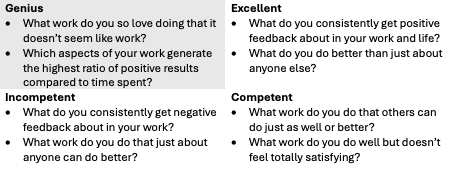
A lot of the 1:1 coaching I do around partnering people towards change and new directions tends to hit this full on. We circle and circle, narrowing options until it becomes clear the coachee has identified what they truly, madly, deeply love. And then we find they’re stuck on the edge of Excellent trying to find the resources to cross into this Genius zone.
Excellent can feel a very good place to be. You’re great at what you do and people love you for it. The rewards will likely be high. And for many, this will be enough. But in time it’s a plateau. Some of the joy starts to go, stagnation sets in. While yes, for sure, Genius is hard. There’s a lot you have to say no to. There’s a lot you have to find in yourself to make that ongoing commitment.
In addition to social and cultural factors, Hendricks identifies four primary personal beliefs that stop us at that change boundary.
Feeling fundamentally flawed – The belief that someone cannot expand into their full creative genius because something is inherently wrong with them.
Disloyalty and abandonment – The belief that someone cannot experience full success because it would be disloyal to their roots and they would end up alone.
More success equals bigger burden – The belief that someone can’t expand to their highest potential because they will have burdens to handle – more to do, people who want things from them, less time for anything else, etc.
Outshining – The belief that if someone expands to their full success, they would outshine someone important to them, making that person look or feel bad.
I doubt many ever leap straight to one of those in a coaching conversation. Typically, we have to work through ‘wrong time’, ‘too many personal commitments’, ‘financial pressures’, and all the other perceived obstacles. They’re familiar excuses. I’ve used them myself for years with my fiction writing. Still do when I drop back below the line of conscious leadership. But when we dig deeper to root cause, one of the four above usually rears its head, most commonly the first one, Imposter Syndrome by another name. It certainly is with me.
As we all know, behavioural change requires an initial mindset change. It requires a re-evaluation of beliefs, maybe even of values. Right at the beginning of their book, Dethmer, Chapman, and Klemp set their stall out by saying the first mark of conscious leaders is self-awareness and the ability to tell themselves the truth.
What are the beliefs holding you back from your Zone of Genius?
Julian
Get in touch if you’re looking for a coach for your / your team’s / your org’s way forward


Leave a Reply